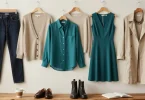
“I have nothing to wear” in front of a full wardrobe is not a clothing shortage; it is a style definition problem. The clothes were bought one impulse at a time, each for a slightly different imagined person, and none of them agree with each other. Learning how to find your personal style is not a makeover montage or a shopping spree — it is an audit and a naming exercise, done mostly with what you already own, that ends with a wardrobe where the pieces cooperate. Style, properly understood, is just a repeatable answer to the question of how you want to show up, and repeatable answers can be built methodically by anyone.

Step One: Audit What You Actually Wear
Data before inspiration. For two weeks, photograph every outfit you genuinely wear — not the ones you plan, the ones that happen — or simply note them in a list. Then pull the evidence together and interrogate it. Which pieces repeat? Which colours dominate the repeats? Which items make you feel most like yourself in the photos, and which outfits were worn once and quietly regretted? Now open the wardrobe and meet the other population: the never-worn, the kept-for-a-life-you-do-not-live, the almost-right. The gap between the worn list and the wardrobe is your current style problem stated precisely, and its pattern — too formal, too fussy, wrong colours, wrong fits — tells you more than any quiz. Your real style is already hiding in the repeat outfits; the audit simply drags it into the light where it can be named and multiplied.
Step Two: Name It in Three Words
The stylist’s oldest tool is the three-word method: reduce your style to three adjectives that every purchase must satisfy. Choose them from the audit’s evidence, not aspiration — if the repeats are clean lines, dark colours and one statement piece, your words might be “minimal, sharp, bold”. If they are soft fabrics, earth tones and vintage cuts, perhaps “relaxed, warm, romantic”. The words must be able to argue with each other productively and, crucially, to veto: hold any candidate purchase against all three and require at least two strong yeses. This is also where the archive work ends and the structure begins — with words named, a wardrobe can be pruned and rebuilt around capsule wardrobe essentials that all speak the same language, which is why dressed-in-five-minutes people look intentional: their wardrobes contain no dissenting pieces.
Step Three: Build a Uniform (Yours, Not Theirs)
Every person with recognisable style runs on a uniform — a formula repeated with variations: the same silhouette, palette and finishing touches, recombined. Find yours by taking the audit’s best outfit and abstracting it: not “the blue dress” but “fitted top, fluid bottom, structured layer, one metal accent”. Write two or three formulas covering your real life — work days, weekends, evenings — in proportions you can repeat with pieces you own or deliberately acquire. A uniform is not monotony; it is the frame that lets variation read as style rather than randomness, and it is the practical secret behind both the minimalist’s calm and the maximalist’s coherence. Fit belongs inside the formula: a silhouette that suits your body, repeated, flatters more reliably than novelty that fights it, a principle as true for the finishing details — the argument in our site’s piece on how quiet luxury works about restraint applies from hemlines to jewellery.
Step Four: Test With What You Own Before Buying Anything
Style found by shopping is usually style rented from a trend cycle. Instead, spend a month as your own stylist with the existing wardrobe: enforce the three words on every outfit, remix pieces into combinations you have never worn, borrow the “wrong” layer, move the evening piece into daylight. Photograph the experiments with the audit’s honesty. The pieces that survive the month have earned their rails; the ones that fail every formula are the honest donations. Only now write a shopping list, and notice its character has changed: it names gaps in formulas (“a mid-weight layer in my palette”) rather than objects of desire (“that jacket from the advert”). Shop the list slowly, with the three-word veto armed, trying everything against two existing outfits before the tag comes off. This is slower than a spree and about ten times more effective per pound spent.
Inspiration Without Imitation
Collecting inspiration helps — saving outfits you admire, following people whose dressing pleases you — provided it passes through your own evidence before reaching your wardrobe. The discipline is translation: for every saved image, name what is actually working in your language (the silhouette? the colour story? the one bold piece against quiet basics?) and test that element against your three words and your formulas, with pieces you own, before it becomes a purchase. Admired strangers have different bodies, budgets and lives; their exact items will disappoint on yours, but their principles travel perfectly. Keep a small, curated board rather than an infinite scroll — a style you can hold in your head is a style you can dress from at 7 a.m., which is, after all, the entire point of having one.
Let Style Be a Practice, Not a Purchase
Personal style settles gradually and then keeps evolving at walking pace — bodies change, lives change, tastes ripen — so schedule the audit yearly rather than treating style as a problem solved once. Keep the outfit photos habit if it serves you; retire the pieces that stop passing the three words without guilt, since a wardrobe is a working tool, not an archive of past selves. And hold the whole project at the right size in your life: style is self-presentation, a genuine pleasure and a real form of competence, but its purpose is to make getting dressed stop costing thought — so the thought is free for everything else. Knowing how to find your personal style is finally knowing that it was never in the shops. It was in the repeats, waiting to be noticed, named and worn on purpose.