Quiet luxury is the trend that looks like no trend at all: no logos, no monograms, nothing that announces its price — yet everyone in the room reads the outfit as expensive. The effect is not mysterious once you know where the eye actually gets its information. Understanding how quiet luxury works means learning the real signals of quality — fit, fabric behaviour, colour discipline and grooming — which turn out to be mostly purchasable at ordinary prices, because they are signals of attention rather than of wealth. That is the trend’s open secret, and its genuine usefulness to anyone who dresses on a budget.
Why Logos Stopped Signalling What They Used To
For decades, the logo was a shortcut: an expensive house’s mark certified the quality underneath. Two forces broke the shortcut. Mass production of convincing imitations made the mark unreliable as evidence, and the genuinely wealthy — the original audience — migrated to signals that cannot be copied at a market stall: cloth that drapes a certain way, tailoring that fits to the centimetre, items with no visible branding at all. Quiet luxury is simply that migration becoming visible fashion. Its aesthetic — neutral palettes, classic cuts, immaculate condition — is deliberately hard to date and harder to attribute, which is also why it photographs as timeless. You do not need a billionaire’s tailor to use the code; you need to know which signals the code actually consists of, because most of them are choices, not purchases.
Signal One: Fit Is the Loudest Voice in the Room
Nothing reads expensive like clothing that fits as if made for the body inside it, and nothing reads cheap like the near-miss: shoulders ending an inch too wide, trousers pooling, sleeves swallowing hands. The quiet-luxury wardrobe treats tailoring as part of the purchase price — a mid-range garment altered to the body outperforms a luxury garment worn off the rack with its compromises showing. Know your alterations: hems, waist nips, sleeve lengths and trouser tapers are inexpensive and transformational. Fit discipline extends to condition, the signal nobody lists and everybody sees: pressed seams, un-scuffed shoes, knitwear de-pilled, buttons tight, bags structured. An outfit in perfect repair whispers the entire message by itself. This is also the wardrobe logic behind our companion guide on how to find your personal style: repeat the silhouettes that fit you, in fabrics that behave, and the “expensive” reading follows as a by-product.
Signal Two: Fabric Behaviour and the Neutral Palette
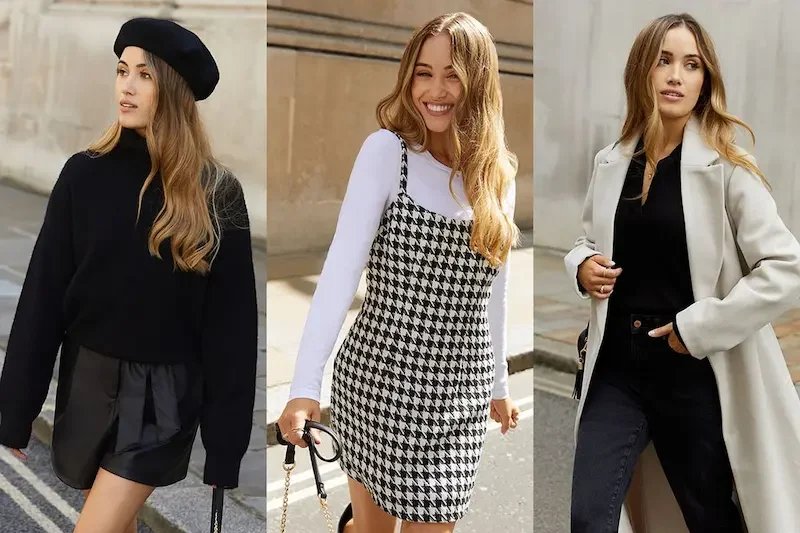
Quality cloth announces itself in motion: wool that falls rather than folds, cotton with body, silk and its convincing modern alternatives that move like liquid, knitwear dense enough to hold a line. Inexpensive fabric betrays itself the same way — shine where there should be matte, creasing that looks tired by ten o’clock, prints that blur at the seams. At a budget, the strategy is triage: spend the fabric money on the large visible surfaces (coat, trousers, knitwear) and buy the quietest versions available — solid colours, no prints, hardware minimal and matte. The palette does half the trend’s work: black, navy, charcoal, camel, cream, chocolate and white, mixed in tones rather than contrasts, read as considered before a single garment is examined. Texture replaces pattern as the interest — rib against smooth, matte against slight sheen — which is why monochromatic outfits in mixed textures are the trend’s signature photograph.
Signal Three: Grooming Is Worn Too
The quiet-luxury image is never only clothing. Hair that looks intentionally kept — the cut maintained, the style calm, chosen for your face the way this site’s guide to hairstyles for round faces matches cuts to features — skin cared for, nails clean and unremarkable, fragrance restrained to personal distance: these are read as part of the outfit and cost mostly consistency. Jewellery follows the same grammar — one or two pieces, real or convincingly quiet, worn daily rather than rotated loudly. Even posture and garment care outside the mirror count: the coat on a proper hanger, knitwear folded rather than hung, shoes rested between wears. The aesthetic is, in the end, an ethic of maintenance — the reason it cannot be faked by a single shopping trip and the reason it is democratic: maintenance is available at every income.
What Quiet Luxury Is Not
Two misunderstandings follow the trend around. The first is that it means beige minimalism for everyone — in fact the code runs in any palette and many personalities; a jewel-toned wardrobe in perfect fit, fine fabric and immaculate condition reads every bit as quiet-luxury as a camel one, since the signals are quality and restraint of branding, not a colour. The second is that it is merely expensive cosplay for the non-rich, a costume of someone else’s life. Read more carefully, it is the opposite: a refusal to spend on the one element — the logo — that adds nothing to the garment, and a redirection of the same money into fit, fabric and care, which add everything. Dressing quietly well is not pretending to be richer; it is declining to pay for advertising worn on your own chest.
Applying It Without Replacing Your Wardrobe
The practical programme is subtraction and polish, in that order. First, audit: remove or retire the logo-forward and novelty pieces from your core rotation (they can live on for the occasions that suit them). Second, neutralise: assemble outfits from your existing solid, dark and neutral pieces and notice how much of the effect you already own. Third, tailor the two or three most-worn items — the alteration budget outperforms any single new purchase. Fourth, establish the maintenance rituals: steamer, lint tools, shoe care, a mending hour monthly. Buy afterwards, slowly, against the gaps, using the fabric and fit tests as your only criteria. Knowing how quiet luxury works returns fashion to something unfashionable: dressing well as a practice of care — for cloth, for fit, for the person inside them — legible to any eye that knows where quality actually lives.